Review: Graphic Spin: Rudyard Kipling Stories
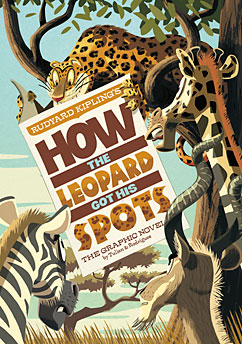
I admit, I never read Kipling’s Just So Stories, but as soon as I read the first page of How the Leopard Got His Spots, I put down the comic and went online to find a full text version. (Thank you Project Gutenberg.) And my instincts were correct… making me like these adaptations even more.
How the Leopard Got His Spots 
By Rudyard Kipling
Adapted & Illustrated by Sean Tulien & Illustrated by Pedro Rodriguez
Recommended for grades 4 & up
Stone Arch Books, PBK ISBN 9781434238818 $5.95 HC ISBN 9781434232236 $16.99
C2012, 40 pp.
ADVERTISEMENT
ADVERTISEMENT
How the Camel Got his Hump –
By Rudyard Kipling
Adapted by Louise Simonson & Illustrated by Pedro Rodriguez
Recommended for grades 4 & up
Stone Arch Books, PBK ISBN 9781434238795 $5.95 HC ISBN 9781434232021 $16.99
C2012, 40 pp.
Rudyard Kipling’s Just So Stories have been around since the early 1900s. The stories were invented for his children, and he eventually wrote them down. These adaptations take the original text and don’t throw away Kipling’s original language but adapt it quite cleverly.
In the How the Leopard Got His Spots, Tulien integrates some of Kipling’s original language into the narration. What’s so clever? He has the characters, the animals and the Ethiopian, interacting with the narrator. (We don’t see a narrator; we just see the narrative text.) Even some of the dialogue is Kipling’s original language, which not only makes the text more authentic but adds flavor to the comic, making it more than just a dry adaptation, like so many classic comic adaptations.
 While the adaptation of How the Camel Got His Hump isn’t as clever, Simonson still uses much of Kipling’s original language and keeps the lighthearted tone of Kipling’s original stories.
Rodriguez’s illustrations in both instances are whimsical. The use of color is perfect, using shades of browns and greens to give the rural feel of the desert and early times. The illustrations are fun and together with the text jazz up what might otherwise be a boring read for students.

Both volumes include extension questions at the back, showing that these books are aimed at the classroom, but the reality is that this would be a fun read for all readers and shouldn’t be limited to classroom collections. It’s a great way to introduce and new readers to these stories—and get them hooked.
Filed under: Graphic Novels, Reviews

About Esther Keller
Esther Keller is the librarian at William E. Grady CTE HS in Brooklyn, NY. In addition, she curates the Graphic Novel collection for the NYC DOE Citywide Digital Library. She started her career at the Brooklyn Public Library and later jumped ship to the school system so she could have summer vacation and a job that would align with a growing family's schedule. On the side, she is a mother of 4 and regularly reviews for SLJ. In her past life, she served on the Great Graphic Novels for Teens Committee where she solidified her love and dedication to comics and worked in the same middle school library for 20 years.
ADVERTISEMENT
ADVERTISEMENT
SLJ Blog Network
Name That LEGO Book Cover! (#53)
Cover Reveal and Q&A: The One and Only Googoosh with Azadeh Westergaard
Fighting Public School Book Bans with the Civil Rights Act
Take Five: Middle Grade Anthologies and Short Story Collections
ADVERTISEMENT